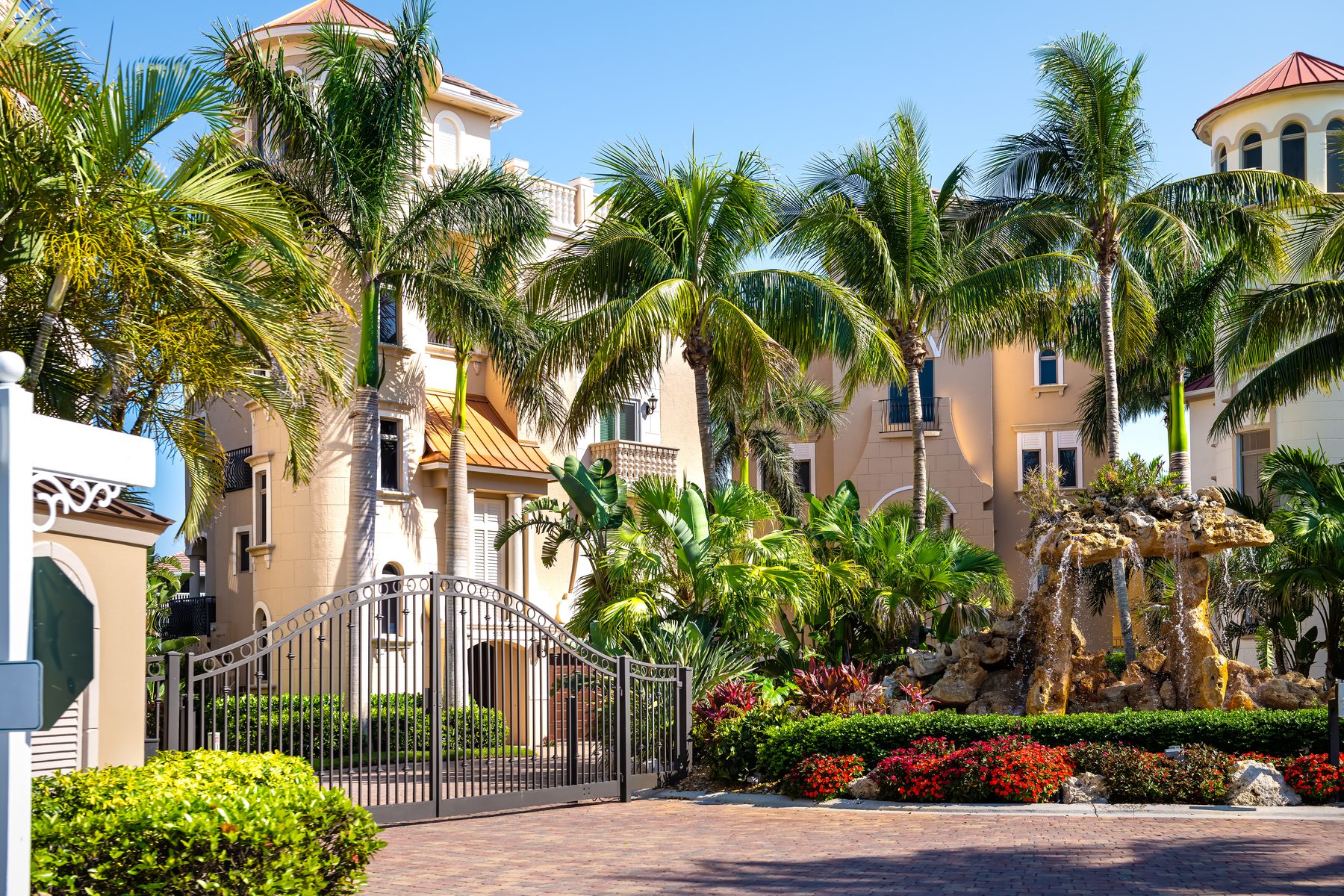
Cascades at Estero is a gated, 55+ community of 614 single-family homes on roughly 158 acres off Estero Parkway, and it is one of the few Levitt & Sons communities in Florida that actually got finished. Levitt and Sons, LLC and thirty-seven affiliates filed for Chapter 11 bankruptcy protection on November 9, 2007 — the same year Cascades' construction wrapped. For a buyer looking at a resale here in 2026, that history has exactly one practical consequence, and it is the thing worth understanding before you write an offer: there is no developer left to finish anything, subsidize anything, or stand behind anything. Everything you can see was paid for and delivered nineteen years ago, and everything from here is the association's. That makes three documents — the reserve study, the current budget, and the estoppel certificate — matter more here than the amenity tour does.
This is a community guide, so we will cover the homes, the pricing, the amenities and who the place actually fits. But we are going to lead with the builder's collapse, because it is the one fact about Cascades at Estero that no listing description mentions and that genuinely changes how you should read the association's paperwork.
What the builder's bankruptcy did — and did not — do
The primary record is a published federal bankruptcy opinion. In In re Levitt & Sons, LLC, 384 B.R. 630 (Bankr. S.D. Fla. 2008), Judge Raymond B. Ray recorded that Levitt and Sons, LLC and thirty-seven affiliated entities filed voluntary Chapter 11 petitions on November 9, 2007 — thirty-eight debtors in all. The opinion dealt with debtor-in-possession financing, and the judge described the people on the other side of it plainly: the "Home Purchase Deposit Creditors" were individuals who had contracted to buy homes from the debtors, and "Many of these creditors are retired or approaching retirement age." The court wrote that the loan "is the best hope for the Home Purchase Deposit Creditors to have their homes and communities finished," and that "The potential impact of the loan on these floundering communities could be substantial."
Two homeowners associations appeared in that docket as objectors — the Seasons on Lake Lanier Community Association and the Cascades at World Golf Village Homeowners Association, a different Levitt community on the other side of the state. Cascades at Estero was not among them. By November 2007 this community was essentially built and sold, and the homes and the clubhouse were already standing.
Here is the part that surprises people, and it is a matter of statute rather than opinion. Florida's turnover law, section 720.307 of the Florida Statutes, lists the events that force a developer to hand board control to the members. One of them, subsection (1)(d), is triggered "Upon the developer filing a petition seeking protection under chapter 7 of the federal Bankruptcy Code." Chapter 7 — a liquidation. Levitt filed chapter 11, a reorganization. The statute's bankruptcy trigger is narrower than almost every buyer assumes, and on these facts it did not fire.
What did apply were the ordinary thresholds. Under section 720.307(1)(a), members other than the developer elect at least a majority of the board three months after 90 percent of the parcels in all phases have been conveyed. Under subsection (2), they elect at least one director once 50 percent are conveyed, and under subsection (3) the developer keeps a seat only while it still holds at least 5 percent of the parcels for sale. At a community that had already sold out, those thresholds were reached on their own. The statute also covers a developer "abandoning or deserting its responsibility to maintain and complete the amenities or infrastructure" under subsection (1)(c), a developer losing title through foreclosure under (1)(e), and a court-appointed receiver not discharged within thirty days under (1)(f).
So the honest version is this: the bankruptcy is not what transferred Cascades at Estero to its residents — being finished and sold out is. But the bankruptcy is why there has been no one to go back to since, and that is what you are buying into.
For contrast, look at what happened at a Levitt community that did not get finished. At Cascades at Sarasota — a separate 450-home community on the other coast, not this one — the Observer reported in October 2009 that nearly 400 homes had sold before the filing, 54 lots sat empty, and Bradenton-based Medallion Home bought the remainder from Levitt for about $3 million on September 25, with bankruptcy court approval required. Levitt's parent posted a $169.2 million loss that year. Medallion told residents it would transfer development control once 90 percent of homes were sold. That is the version of this story where a buyer inherits an unfinished community and a successor developer. Cascades at Estero is the other version, and it is the better one.
The community, the homes, and the pricing
Cascades at Estero sits off Estero Parkway between U.S. 41 and Three Oaks Boulevard, with roughly a dozen to fifteen lakes threaded through about 158 acres. It is deed restricted, gated, and age restricted at 55+. There is no golf course — the pitch has always been country-club amenities without the club. Levitt & Sons sold here from 2002, with most homes dating from roughly 2003 to 2007.
Floor plans run 1,525 to 2,536 square feet, two to three bedrooms, two or three bathrooms, with attached two-car garages. The marketed series carried names like Anastasia and Carrington at the smaller end. This is single-story Florida ranch product with tile roofs, not a luxury band — and the pricing reflects that.
On the numbers: an agent community page reporting Southwest Florida MLS data for the twelve months ending October 21, 2026 shows 40 closings, a median sale price of $408,750 and a mean of $417,831, a range of $275,000 to $650,000, a median 36.5 days on market, a median sale-to-list ratio of 95.6 percent, a median 1,785 square feet of living area, and a median $223.64 per square foot. The same page gives annual medians of $491,000 for 2022, $490,000 for 2023, $455,000 for 2024, $457,500 for 2025, and $418,000 for 2026 through October 21. Those are agent-page figures drawn from MLS, not our own pull, and we are attributing them as such — but the direction is consistent and it is the clearest multi-year series available for this community.
On the dues, we are going to give you a spread rather than a number, because the sources disagree and we would rather be useful than confident. Our own Tidewater by Del Webb guide reports dues at $1,180 per quarter, which works out to about $393 a month. One community page states a flat $380 per month. A national 55+ listing site gives a monthly range of $299 to $521. And one agent page, to its credit, declines to publish a figure at all, on the grounds that the association's budget is not public. Those are all in the same neighborhood, which is reassuring, but none of them is the association's own document. The estoppel certificate is, and we will come back to it.
There is no Community Development District on the parcel record here, which means no CDD assessment stacked on top of the HOA dues — a meaningful difference from much of the newer construction east of I-75. If you are weighing Cascades against a newer Estero community, our guide to CDD fees in Bonita Springs and Estero explains what that line would have added.
Amenities and who this community actually fits
The clubhouse is the heart of it, reported at roughly 28,000 square feet, and the amenity list is unusually deep for a community at this price. There is a resort-style outdoor pool with a spa and sundeck, an attached indoor pool — genuinely rare in Southwest Florida — and a second satellite pool at the western end of the community. Inside: a fitness center with a dance and aerobics studio, sauna and showers, a grand ballroom with a stage and dance floor, a billiards room, two card rooms, a media room, a library, and a hobby room with pottery kilns. Outside: Har-Tru tennis courts with a pro shop and a tennis director, bocce, and pickleball. Sources disagree on the exact court count — some report six Har-Tru courts, one reports five plus four pickleball courts — so treat the count as approximate and confirm it on a visit. There is a full-time lifestyle director.
Who it fits: a buyer who wants an established, socially active 55+ community with real amenities and a mid-$300K to mid-$500K entry point, who does not want golf and does not want to pay for it, and who is comfortable with a 2000s-vintage home. Who it does not fit: anyone who wants new construction, anyone who needs a golf membership attached to the deed, and anyone who wants an association still backed by a developer's deep pockets. That last one is the real filter, and it is not a flaw — it is simply the trade, and it is the trade at every built-out community in Estero. Our Estero buyer's guide and Estero relocation guide set the wider context.
One thing we could not establish and will not guess at: whether Cascades at Estero sits inside the Village of Estero's municipal limits or in unincorporated Lee County. The Village was incorporated on December 31, 2014 after a referendum on the November 4, 2014 ballot passed with 86 percent of the vote, and its own adopted Comprehensive Plan — Ordinance 2018-01, adopted June 13, 2018 and amended by Ordinance 2019-24 on September 25, 2019 — names Wildcat Run, West Bay Club, The Estates at Estero River, The Brooks and Pelican Landing as example neighborhoods in one Village district, and Coconut Shores, Fountain Lakes, Corkscrew Woodlands, Copper Oaks, Breckenridge and Villagio in another. Cascades at Estero is not named in either list. That is not evidence either way, and the question matters — it determines your millage, your code enforcement, your permitting counter and your flood-program discount. Our walkthrough on how to check whether an Estero address is inside the Village limits shows how to settle it for a specific parcel, and our Estero flood-risk guide explains why the jurisdiction answer changes your insurance math.
The buying process at a community with no developer
At a new-construction community, the builder's sales center is the gatekeeper and the contract is the document that matters. Here, neither exists. The association is the counterparty, and Florida gives you a statutory tool to interrogate it.
Section 720.30851 of the Florida Statutes governs the estoppel certificate. The association must issue it within ten business days of a written or electronic request. It is effective for thirty days if hand-delivered or sent electronically, thirty-five if sent by regular mail. And the statute prescribes what must be in it: the regular assessment amount and frequency, the paid-through date, the next due date and amount, an itemized list of everything owed, amounts scheduled to come due during the certificate's effective period, any capital contribution, resale, transfer or other fee, open violations, whether board approval is required for the transfer, whether any right of first refusal exists, other associations the parcel belongs to, and insurance contacts. That list is the answer to nearly every question this article has had to leave as a spread.
The fees are capped by the same statute: no more than $250 to prepare and deliver it when nothing is owed, an additional $100 for expedited delivery within three business days, and no more than $150 extra if the account is delinquent. One note on those caps, and it matters: the statute requires the figures to be adjusted every five years based on the Consumer Price Index, so the current ceiling is higher than the numbers printed in the statute text. We have seen $299, $119 and $179 reported for this community's estoppel. We are publishing the statutory mechanism and the base caps because those we can verify; we are not asserting a current adjusted figure we could not confirm from the Department's own publication.
On the association itself, the public corporate record is thin but useful. Cascades at Estero Residents' Association, Inc. appears in the Florida Division of Corporations under document number N03000002942, filed April 7, 2003, status active, with one vote per lot and a declaration recorded at Official Records Book 3706, Page 4023. We confirmed that document number independently through the Division's own search index. Who manages the association day to day we could not pin down — one source names one management company, other listings name a different one — so we are not publishing a name. The estoppel will state it.
Two figures we are deliberately not re-litigating here, because we have already published them and because they are agent-page numbers rather than association documents: the transfer fee and application fee reported for Cascades, which appear with their caveats in our Tidewater guide. The statute above is what settles them. And the 55+ occupancy mechanics — which recorded instrument actually governs who may live in a home, as opposed to what a community page says — are covered in that same guide, which is the better place to read them.
What would we look at first if you called us about Cascades at Estero?
Honestly? Not the clubhouse. We would start with the association's financial position, because at a nineteen-year-old community with no developer behind it, that is where your risk lives and it is the one thing a showing cannot tell you.
The first thing we would pull is the reserve study rather than the reserve balance — a balance is a snapshot, a study is a forecast, and the gap between the two is where special assessments come from. Then the current adopted budget, to see what the association is actually funding versus what it is deferring. At a community with a 28,000-square-foot clubhouse, two pools, an indoor pool, a staffed gate and a tennis facility, the replacement schedule on all of that is carried by 614 homes and nobody else. We would want to know where it sits in its cycle, what has already been replaced, and what has not. Then we would read the estoppel against the budget, because the estoppel is where a pending assessment or a fee nobody mentioned has to surface, and we would want any discrepancy between the two in front of you before your inspection period runs, not after.
What that gets you is simple: you walk into the deal knowing whether the dues you were quoted are the dues you will pay, and whether the amenities you are buying are funded or borrowed against. When it is handled well, there are no surprises in year two. That is the part we take care of for you.
How Cascades at Estero compares
The closest local comparison is Tidewater by Del Webb, the other established 55+ community in Estero — newer, smaller, and built out by a builder that still exists. Our Tidewater guide carries the full head-to-head on homes, dues and transfer fees, so we will not repeat it here. The structural difference worth naming is the one this article is about: Tidewater's developer completed the community and moved on; Cascades' developer completed the community and then ceased to exist. In practice both are now resident-run associations with no builder warranty and no developer subsidy. The difference is that at Cascades there is no corporate entity anywhere to ask a question of, which raises the value of the paperwork and lowers the value of reassurance.
Further afield, Pelican Preserve in Fort Myers offers a larger amenity footprint with golf available, and Valencia Bonita in Bonita Springs is the newer-construction 55+ alternative at a higher entry point. If what draws you to Cascades is the indoor pool and the social calendar rather than the address, both are worth a look.
For the generic version of the homework — what to request from any Florida association and how to read it — our process guide on how to evaluate a Florida HOA before buying covers the reserve study and funded-ratio thresholds in detail, and HOA approval for buyers covers the application side. If you are selling at a community like this, selling with a special assessment on the books is the one to read.
Frequently asked questions
Who built Cascades at Estero, and what happened to the builder?
Levitt & Sons built Cascades at Estero, selling from 2002 with most homes completed between roughly 2003 and 2007. Levitt and Sons, LLC and thirty-seven affiliated entities filed voluntary Chapter 11 bankruptcy petitions on November 9, 2007, as recorded in In re Levitt & Sons, LLC, 384 B.R. 630 (Bankr. S.D. Fla. 2008). Cascades at Estero was essentially finished and sold out by then, so unlike many Levitt communities it was not left with unbuilt homes or unfinished amenities. The practical effect today is that no developer entity remains behind the community.
Did the builder's bankruptcy trigger the handover of the association to residents?
No. Section 720.307(1)(d) of the Florida Statutes triggers transition of association control "Upon the developer filing a petition seeking protection under chapter 7 of the federal Bankruptcy Code." Levitt filed under chapter 11, not chapter 7, so that specific trigger did not apply. Control at a sold-out community like Cascades passes under section 720.307(1)(a) instead — three months after 90 percent of the parcels in all phases have been conveyed to members other than the developer.
What are the HOA dues at Cascades at Estero in 2026?
Published figures disagree and none of them is the association's own document. Our Tidewater guide reports $1,180 per quarter (about $393 a month); one community page states $380 a month; a national 55+ listing site gives a range of $299 to $521 a month; and one agent page declines to publish a figure because the association's budget is not public. Request the estoppel certificate, which under section 720.30851 must state the regular assessment amount and frequency, the paid-through date, and any transfer, resale or capital contribution fee. There is no CDD assessment on the parcel record here.
Is Cascades at Estero in the Village of Estero or unincorporated Lee County?
We could not establish this from a primary source and will not guess. The Village of Estero was incorporated on December 31, 2014, and its adopted Comprehensive Plan names a number of example neighborhoods inside the Village — Cascades at Estero is not among them, which proves nothing either way. The answer changes your millage rate, your permitting authority and your flood-program discount, so verify it for the specific parcel before you close.
What should I read before making an offer at Cascades at Estero?
Three documents, in this order: the reserve study, the current adopted budget, and the estoppel certificate. At a nineteen-year-old community with a large shared amenity package and no developer behind it, the replacement cost of the clubhouse, pools, gate and courts is carried entirely by the 614 homes. The reserve study forecasts it, the budget shows what is being funded now, and the estoppel is where any pending assessment or undisclosed fee is legally required to surface.
Sources and how we read them. In re Levitt & Sons, LLC, 384 B.R. 630 (Bankr. S.D. Fla. 2008) (Ray, J.) for the petition date, debtor count and quoted passages; sections 720.307 and 720.30851, Florida Statutes, read on the Florida Legislature's own site, for the turnover triggers and the estoppel requirements and fee caps; the Village of Estero Comprehensive Plan (Ordinance 2018-01, adopted June 13, 2018, amended by Ordinance 2019-24, September 25, 2019) for the incorporation date and the Village neighborhood examples; the Florida Division of Corporations search index for association document number N03000002942; the Observer (October 2009) for the Cascades at Sarasota sale to Medallion Home, a different community included here only as a contrast. Community statistics, dues figures, amenity counts and MLS-derived sales data are from community and agent pages as cited in the text and are attributed rather than asserted; where they disagree we have published the spread. Every date in this article was checked against the calendar.