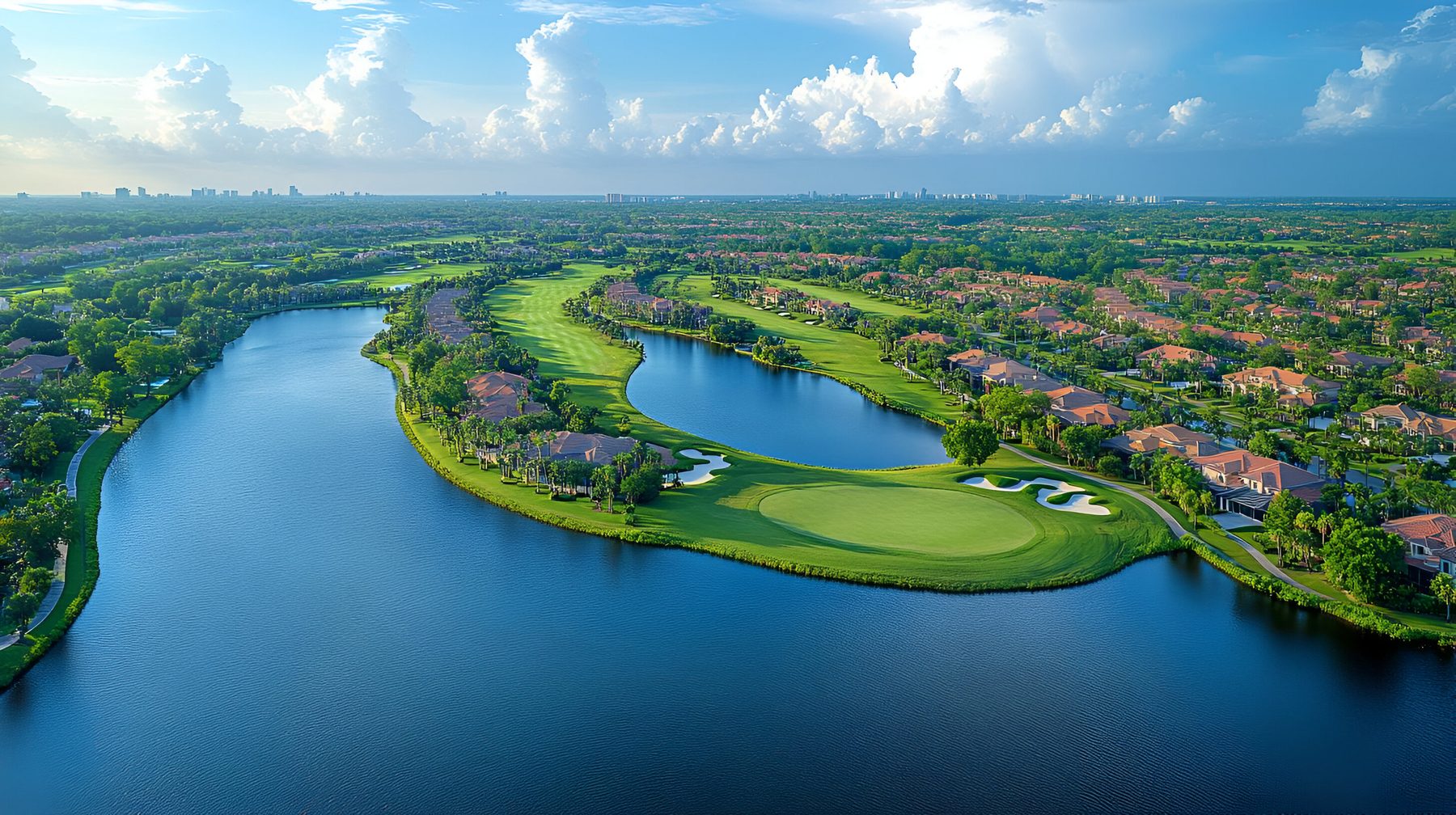
What does Pelican Sound's bundled fee actually cover?
Pelican Sound Golf & River Club in Estero, FL charges a mandatory 2026 annual assessment of $11,495 per residence — up from $10,745 in 2025 — and that single number covers 27 holes of golf, four restaurants, 14 pickleball courts, eight tennis courts, six pools, a fitness center, and a members-only boat ramp with Gulf access by way of the Estero River. What it does not cover is your neighborhood association fee, which is billed separately every quarter, or the one-time club fee at closing: $20,300 if you have never owned here, or $11,495 if you have. All in, plan on roughly $14,300 to $15,100 a year in carrying cost before boat storage, and roughly $21,000 at the closing table if you are a first-time Pelican Sound buyer.
That gap between the two closing-day numbers is the single most expensive thing most buyers don't know about this community, and it is where we start every conversation about it.
Bundled golf is one of the most searched and least understood structures in Southwest Florida. Buyers see a $324,900 condo in Estero with a 27-hole course attached and assume they've found a bargain. Sometimes they have — but the listing price tells you almost nothing about what the home costs to own.
The community: 1,299 homes on 547 acres along the Estero River
Pelican Sound was developed by WCI Communities on 547 acres in Estero (zip 33928), bordered by the Estero River and backing to Koreshan State Park. The golf course opened in May 1998, the River Club followed in September 1999, and the main clubhouse opened on New Year's Eve 1999. Management transferred from the developer to the members in January 2003, which matters more than it sounds: this is a member-run club, so dues decisions are made by owners, not by a developer with an exit strategy.
There are 1,299 residences, and the club caps memberships at that same number. Membership is tied to ownership — no social tier, no waitlist, and no way to buy in and skip the golf.
The community is organized into roughly a dozen separately governed neighborhoods — Torrey Pines, Sandcastle, Edgewater I through IV, Seaside I through III, Hammock Greens I through IV, Gleneagles, Island Sound I and II, The Masters, Oak Run, Palmetto Dunes, Southern Hills, Turnberry I and II, and Pinehurst. Each one has its own association, its own management company, and its own quarterly fee. That structure is the part buyers most often miss, and it's the same fragmentation we flagged when we wrote up Gateway in Fort Myers: the community-level number you find online is never the whole bill.
Homes and pricing in October 2026
Inventory runs from two-bedroom condos to estate homes, and the spread is wide.
- Condos — roughly 1,207 to 1,560 square feet, in two- and four-story buildings, no high-rises. Currently listed from about $294,500.
- Coach and carriage homes — roughly 1,450 to 1,759 square feet, one- or two-car garages. Mostly $370,000 to $650,000.
- Executive and single-family homes — roughly 1,700 to 2,200 square feet.
- Pinehurst estate homes — 81 homes, roughly 2,100 to 3,100 square feet.
As of October 2026 there were 13 active condo, coach, and carriage listings ranging from $294,500 to $875,000, all built between 1999 and 2002. Recent sales reach up to about $1.4 million at the estate end.
The trailing-90-day closings tell the more useful story. Low-rise properties averaged $530,000 at $342 per square foot, 97 days on market, closing about 6.9% under asking price. Mid-rise properties averaged $320,000 at $246 per square foot — but 235 days on market. That mid-rise number is the one to sit with: nearly eight months to sell is slow even in a soft market. For context, Estero as a whole is running a $495,000 median sold price, down 5.8% year over year, at 69 days on market and 92.7% of asking price.
A 235-day average on market is not a disaster — it's leverage. In a community where carrying costs are fixed and high, every month a unit sits is pressure on the seller. That's a negotiating position, and it's the reason we tell buyers here to go in with a number, not an apology.
Flood zones and insurance: the part worth checking first
Pelican Sound sits on a tidal river that connects to Estero Bay, so flood exposure is not hypothetical. Hurricane Ian pushed Gulf water up the Estero River in September 2022.
Flood zones here are drawn parcel by parcel. Sections along the river and toward the bay map into FEMA AE zones; other sections map into Zone X. Two homes in the same community — even on the same street — can carry completely different flood requirements and premiums. Pull the FEMA flood map and any available elevation certificate for the exact address before you write an offer, the same discipline we lay out in our guide to which Southwest Florida flood zones to avoid and which to buy in.
Two things work in your favor. First, the Village of Estero holds a Community Rating System Class 6 rating, which earns a 20% discount on NFIP flood insurance premiums. FEMA signaled in March 2024 that it intended to reduce that discount; Estero submitted a corrective action plan, and on November 21, 2024 FEMA confirmed the Class 6 rating and the 20% discount would stand. That's real money every year, and almost no listing mentions it.
Second, these homes were built roughly 1999 to 2005, straddling the March 2002 Florida Building Code change. Carriers price on documented roof age and wind-resistance features, not the year on the deed — so a unit with a permitted newer roof and a current wind mitigation report can qualify for meaningfully better pricing than its neighbor. Order the four-point and wind mitigation inspections early, not after you've waived contingencies. And NFIP building coverage caps at $250,000, so above that you're on the private excess market.
Amenities and lifestyle: who this community actually fits
The amenity package is unusually deep for the price point, which is the honest case for paying the bundled fee.
Golf: 27 holes designed by Chip Powell and Mike Hill, Audubon certified, with a practice facility, aqua driving range, and golf shop. Residents-only play, so tee time competition is capped at 1,299 households rather than open to outside members.
Racquet and courts: 14 pickleball courts, eight hydro-grid tennis courts, and five bocce courts. Fourteen pickleball courts is a serious commitment — most Estero communities have two to six.
Water: this is what sets Pelican Sound apart from every other bundled golf community in the area. A members-only boat ramp on the Estero River with access to Estero Bay and the Gulf, 125 fenced dry-storage lots leased from the club ($625 and up annually, or $80 and up monthly), 11 trailer spots, 10 wash bays, a compressed air station, and a fish-cleaning station. Kayaks and paddleboards are free to residents. The club also runs a free shuttle boat to Lovers Key State Park — about a two-hour round trip. Practical boat size is limited by the river; plan on roughly 24 feet, and verify against your specific vessel before you buy.
Everything else: four dining venues (The Vista at the clubhouse, the Pavilion, the Pelican Pub, and the River Club), six pools plus six spas and a kiddie pool, a fitness center and outdoor fitness park, three fire pits, a dog park, playground, half-court basketball, and horseshoe pits.
So who does this fit? Someone who will use both the golf and the water. If you golf regularly and keep a boat, $11,495 a year for unlimited play, a ramp with Gulf access, dry storage, four restaurants, and a full racquet program is defensible math — paying separately for a golf membership and a marina slip in Lee County would cost more. If you golf but don't boat, you're paying for a marina you won't use. And if you don't golf at all, you're subsidizing a course for your neighbors, and you should be looking elsewhere in Estero.
The buying process: what to do before you tour
Pelican Sound is a resale-only community, so there's no builder rep and no incentive timing to play. But the approval and fee mechanics catch people out. Do these five things before you schedule a showing, not after you fall in love with a unit.
- Settle which club fee applies to you. First-time Pelican Sound owners pay a $20,300 initiation fee at closing. Owners and former owners pay an $11,495 resale capital fee. Only one applies. Get it in writing from the club before you make an offer — this is nearly a $9,000 swing and it is not negotiable with the seller.
- Get the specific neighborhood's quarterly fee in writing. The $11,495 is club-wide. Your neighborhood association fee is separate, varies by neighborhood, and is commonly in the ballpark of $700 to $900 per quarter. Confirm the actual current figure with that neighborhood's management company and ask what it includes.
- Order both estoppel letters. There's a $299 club estoppel fee and a separate neighborhood estoppel fee. An HOA estoppel letter is where unpaid assessments, pending special assessments, and transfer costs surface — and at least one current listing advertises "no assessment" for a roof project, which tells you other buildings here do have one. Ask directly about roof, paving, and reserve projects in that building.
- Start the purchase application 20 business days out. The neighborhood association requires an Application for Approval to Purchase completed 20 business days before closing. Miss that window and your closing date moves.
- Price insurance before you're under contract. Flood zone, roof age, and wind mitigation status for that exact unit, quoted — not estimated.
On taxes: the Village of Estero is holding its millage flat at 0.73 mills for fiscal 2026-27, and total Lee County millage runs around 15.97 mills. Your taxes reset to your purchase price when you buy, so the seller's tax bill is not your tax bill. Homestead exemption and the homestead expansion on the November 3, 2026 ballot both matter here. We found no evidence of a CDD assessment at Pelican Sound — a genuine cost advantage over newer Estero communities — but verify it on the actual tax bill for the parcel rather than taking our word or anyone else's. (If CDD math is new to you, start there.)
One more thing about the neighborhood: a 219-unit residential complex has been proposed on the west side of US 41 near Pelican Sound. It still needs rezoning and design changes, so nothing is imminent — but if long-term traffic on that stretch of 41 matters to you, it's worth tracking.
Pelican Sound vs. Grandezza and Stoneybrook
Three Estero golf communities, three different cost structures. The comparison is really about how you want to pay for golf.
Pelican Sound bundles everything into one mandatory assessment. Highest fixed annual cost of the three, lowest entry price for the amenity depth, and the only one with Gulf access and a boat ramp. You cannot opt out.
Grandezza runs a traditional country club model — a separate golf initiation fee and annual club dues on top of the HOA, with lower-tier memberships available. Larger homes, higher purchase prices, and more flexibility if you want the address without the full golf commitment.
Stoneybrook is the value play: no bundled golf, pay-as-you-play, no CDD, and by far the lowest carrying cost of the three. If you golf a dozen times a year, Stoneybrook will almost certainly cost you less, even counting green fees.
The honest version: the bundled fee is either the best value in Estero or an expensive subscription you don't use, and which one depends entirely on how many rounds you'll play and whether you own a boat. That's a conversation worth having with real numbers before you tour anything.
Frequently asked questions
Is golf membership mandatory at Pelican Sound?
Yes. Club membership is tied to ownership of all 1,299 residences and comes with the home whether or not you play. There is no social-only tier and no option to decline. Every owner pays the $11,495 annual assessment in 2026.
Why is the initiation fee so much higher than the resale capital fee?
The club charges a $20,300 initiation fee to buyers who have never owned in Pelican Sound, and an $11,495 resale capital fee — equal to one year's assessment — to current and former owners. It effectively rewards owners who move within the community. Confirm which applies to you in writing before you make an offer.
Does Pelican Sound have a CDD?
We found no evidence of a Community Development District assessment here, which would make it a cost advantage over newer Estero communities carrying CDD debt for 20 to 30 years. Verify on the Lee County tax bill for the specific parcel before relying on it.
How long are homes taking to sell in Pelican Sound?
Over the trailing 90 days, low-rise closings averaged 97 days on market and mid-rise closings 235 days, both selling 6% to 7% under asking price, against 69 days at 92.7% of list for Estero overall. Slower absorption in a high-fixed-cost community favors buyers prepared to negotiate.
Can I rent out a Pelican Sound home?
Leasing is allowed but tightly administered: a $260 lease application fee ($310 in Island Sound 2), a $155 annual renewal fee, and a transfer-of-amenities fee of $465 and up to extend club privileges to a tenant. Individual neighborhoods set their own minimum lease terms, so confirm the rules for that association if rental income is part of your plan.