What do Northeast and Midwest buyers need to know before moving to Cape Coral, FL?
Cape Coral, FL's single-family median home price sits at $368,999 as of mid-2026, with homes taking a median of 55 days to sell and the market running at roughly five months of supply — a genuine buyer's market after the frenzy of 2021-2022. Florida has no state income tax, and Cape Coral runs about 20% cheaper than nearby Naples on everyday costs. But the city's canal network, its Utilities Extension Project assessments, and its flood zone patchwork catch most Northeast and Midwest buyers off guard. Here's what actually matters before you sign a contract.
Cape Coral keeps landing on relocation shortlists for buyers leaving New York, New Jersey, Ohio, and Michigan, and the moving industry's own booking data backs it up — routes from Pittsburgh, Cincinnati, Detroit, Toledo, and Rochester to Cape Coral show up constantly in interstate mover pricing tools. Florida ranked the No. 2 state for in-migration in 2025, behind only Texas, while California, Illinois, New Jersey, New York, and Massachusetts posted the biggest population losses. Ohio had the single largest drop in the growth rankings of any state. If you're reading this from one of those states, you're not an outlier. You're the pattern.
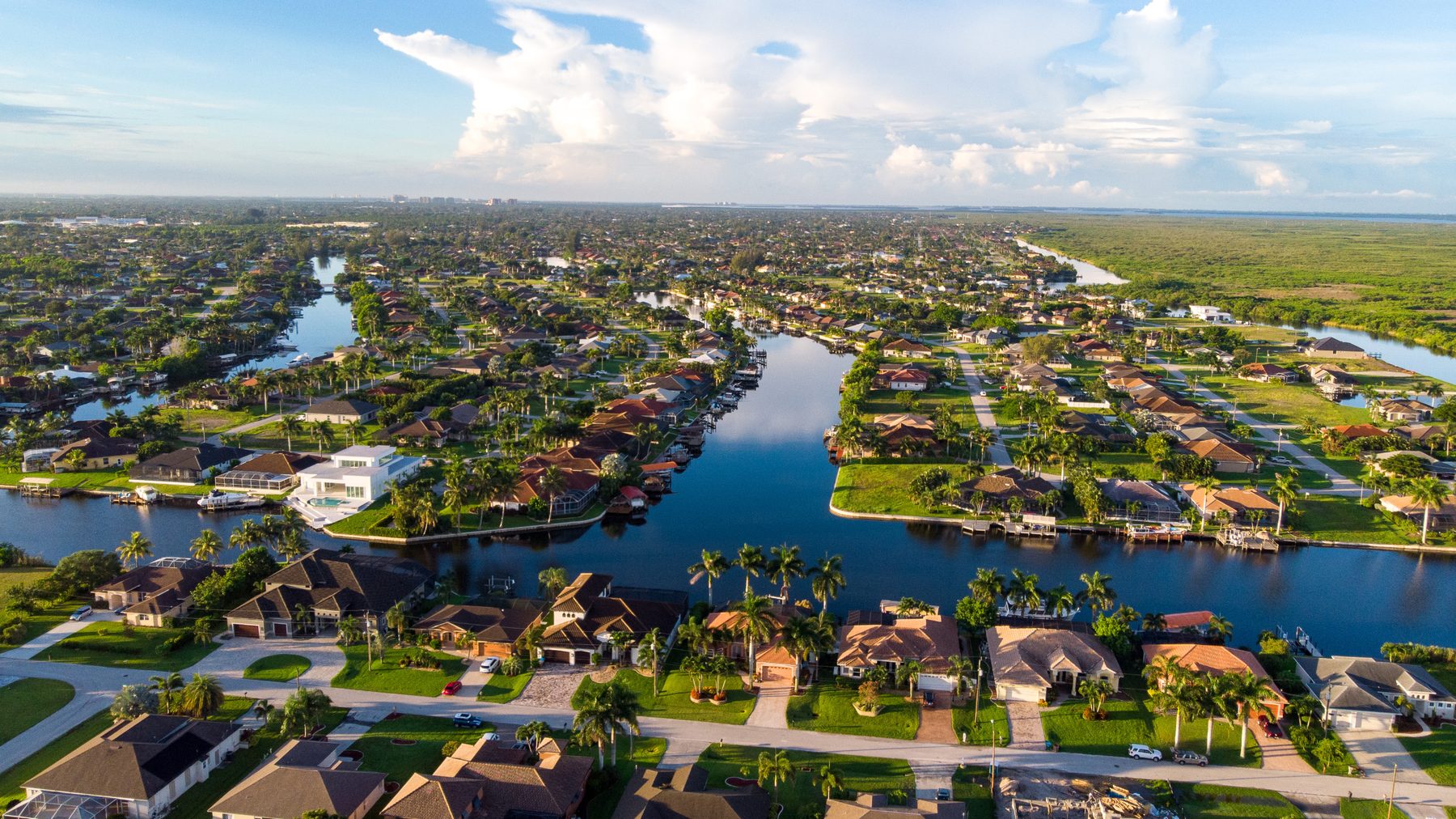
But Cape Coral isn't Naples with cheaper price tags, and it isn't Fort Myers with more canals. It's its own thing — a 120-square-mile grid platted in the 1950s and 60s with more canal miles than any city in the world, split into four quadrants that feel genuinely different from each other, with a utility and flood-zone system that trips up buyers who assume one part of town works like the rest. If you're coming from a place where winter is a season you plan your whole year around, here's what you actually need to know.
Why Cape Coral draws Northeast and Midwest buyers
The headline pitch is the one you already know: no state income tax, warmer weather, and a lower cost of living than wherever you're calling from. Florida doesn't tax wages, pensions, retirement account withdrawals, or capital gains at the state level. If you're relocating from New Jersey and earning $150,000, you're looking at roughly $8,000 to $9,500 a year back in your pocket depending on your bracket — New Jersey's rate runs 6.37% on income between $75,000 and $500,000. Coming from Ohio, the math is gentler since Ohio has cut its own rates toward some of the lowest in the country, but it's still taxing wages Florida doesn't touch at all.
Cape Coral adds its own case on top of the general Florida pitch, and it's mostly about price. A typical single-family home here runs around $375,000, against roughly $725,000 in Naples — a gap wide enough that a comparable home in North Naples can cost $300,000 more than its Cape Coral equivalent. A family of four can expect an all-in monthly budget of $4,200 to $5,400 in Cape Coral, versus $5,800 to $7,500 in Naples, which works out to Cape Coral running about 20% cheaper day to day. If you want an even lower entry point, nearby Lehigh Acres runs a typical price around $300,000 with a $3,700 to $4,700 monthly household budget, though it's a different kind of market with its own trade-offs.
Timing is working in buyers' favor right now. Single-family homes are averaging 55 days on market with roughly five months of supply — not a steep decline, but a real normalization from the single-digit days on market of 2021. That gives you room to negotiate and time to actually compare neighborhoods before committing.
Cape Coral's four quadrants: where northern buyers are landing
Cape Coral splits into four quadrants, and which one fits you depends on budget, whether you want boat access, and how much new construction you're comfortable buying into.
Cape Harbour and the broader Southwest Cape is the boater's answer — deep-water, bridge-free canals running straight to the Gulf, a 76-slip marina, and on-site dining. Homes here run from the $400Ks into $2 million-plus for the Cape Harbour enclave itself. The Yacht Club area in the Southeast Cape is the city's oldest and most walkable section, with sailboat-access canals and a median closer to $527,500 — a mix of 1960s homes ready for renovation and newer builds squeezed in between them.
If canal maintenance and bridge clearances aren't what you're looking for, Sandoval is a gated, master-planned community built out between 2005 and 2018 with a pool, fitness center, and fishing pier but no private canal frontage — and many of its homes sit in lower-risk flood zones, which matters more than it sounds like it should (more on that below). Its median runs around $385,000.
The Northwest Cape is the fastest-growing quadrant, with larger lots, newer schools, and new construction in the $300,000 to $500,000 range — though some streets are still filling in, so infrastructure can be a step behind the houses. The Northeast Cape is the most affordable quadrant, dominated by 1970s and 80s homes from $250,000 to $450,000, with some longer-canal waterfront options for buyers willing to renovate and do their homework on a given street.
What it actually costs to live in Cape Coral
Property taxes in Lee County run an effective rate of roughly 1.1% to 1.4% of assessed value. On a $375,000 home, that works out to about $4,200 to $5,000 a year once you've applied the $50,000 homestead exemption — and once you're a permanent Florida resident, Save Our Homes caps your annual assessment increase at 3%, regardless of how much the market moves. That's a meaningful protection if you're coming from a state where property tax bills can jump sharply year over year.
Insurance is the line item that surprises the most northern buyers. Wind, flood, and hazard coverage on a canal-front home typically runs $3,500 to $8,000 a year, depending on the roof's age, the home's elevation, and its flood zone. Most Cape Coral property sits inside a FEMA-designated Special Flood Hazard Area — the city's own flood protection page is blunt that flood zones are assigned parcel by parcel, not neighborhood by neighborhood, so two homes on the same street can carry very different premiums. Flood insurance isn't included in a standard homeowner's policy, NFIP coverage has a 30-day waiting period before it takes effect, and elevation certificates are available through the City Clerk's office for anything built since 1993. Pull the specific property's flood zone and elevation certificate before you write an offer, not after.
The UEP assessment: the cost nobody mentions
If there's one thing that catches out-of-state buyers in Cape Coral more than anything else, it's the city's Utilities Extension Project, or UEP. Large sections of the city were originally built on septic systems and private wells, and the city has spent years running municipal water, sewer, and irrigation lines out to those areas. When your section comes up, connection generally isn't optional — a developed property has 180 days from the city's Notice of Availability to connect, and the costs aren't trivial: a meter installation fee (currently $310), a utility account deposit ($225, sometimes waived), a septic abandonment permit ($100), and a plumber's connection and septic pump-out that recent projects have run $2,000 to $2,500. The broader assessment itself is spread across benefiting properties and can be paid upfront or amortized on the tax bill over 20 to 30 years — and if you choose the amortized route, that balance typically transfers with the property when you sell, though some lenders want it paid off first.
This isn't a reason to avoid Cape Coral. It's a reason to ask, before you buy, whether the specific property is already connected to city utilities, whether a UEP assessment is active or pending on it, and what the remaining balance is if it's being amortized. That's a question your title company and the city's UEP information line can both answer — but it has to get asked.
Schools, healthcare, and daily life
Cape Coral and the surrounding area fall under the Lee County School District, the fifth-largest in Florida; as with any Florida relocation, confirm the specific zoned school for an address rather than assuming based on the neighborhood name.
Healthcare is anchored by Lee Health, the region's dominant system, which operates Cape Coral Hospital along with facilities across Lee County — and Lee Health has been actively expanding access points in Cape Coral as the city's population keeps climbing, including a planned outpatient complex in the western part of the city.
Day-to-day, Cape Coral has filled in considerably over the past decade: a full retail and dining corridor along Cape Coral Parkway and Pine Island Road, waterfront dining tied to the marina districts, and quick access across the Caloosahatchee River bridges into downtown Fort Myers for a bigger-city fix. If you're moving here permanently rather than as a seasonal resident, budget for a car-dependent lifestyle, especially in the Northeast and Northwest Cape — sidewalks and transit are thin outside the older, more walkable Yacht Club area.
What out-of-state buyers should expect in the process
Florida closings run through a title company, not an attorney, which surprises buyers coming from attorney-review states like New York and New Jersey. A four-point inspection and a wind mitigation inspection are standard here, separate from your general home inspection — the four-point evaluates the roof, electrical, plumbing, and HVAC systems and is typically required by insurers on homes over 10 to 15 years old, while the wind mitigation inspection documents hurricane-resistant features and can meaningfully lower your premium. Budget $300 to $500 combined for both, and get them done before you waive any contingencies.
If you're buying resale, request the Seller's Property Disclosure and ask directly about UEP status, canal type and water access, and any wind mitigation or roof documentation the seller already has on file. If the home is in an HOA, order the estoppel letter early — it confirms dues, any pending special assessments, and whether the association is financially healthy, and it can take HOA management companies a week or more to produce.
Mistakes northern relocators make
The most common mistake is assuming "canal lot" means one thing. Cape Coral has sailboat-access canals that reach the Gulf without a fixed bridge, bridge-restricted canals that cap boat height, and freshwater canals that don't reach open water at all — and the difference changes both what you can do with a boat and what the home is actually worth.
The second is treating the whole city as one insurance and flood-risk profile. Sandoval and much of the Northwest Cape sit in comparatively lower-risk flood zones; large parts of the older Southeast and Northeast Cape sit inside mapped Special Flood Hazard Areas. Get the specific parcel's flood zone before you fall in love with a house.
The third is skipping the UEP question entirely, because most out-of-state buyers have simply never heard of it. A home that looks like a bargain can come with a five-figure assessment balance still being paid down on the tax bill — find out before you're the one who inherits it.
Frequently Asked Questions
Is Cape Coral cheaper to live in than Naples or Bonita Springs?
Yes, by a meaningful margin. A family of four can expect an all-in monthly budget of roughly $4,200 to $5,400 in Cape Coral, compared with $5,800 to $7,500 in Naples — about 20% lower across housing, groceries, utilities, and transportation.
Does every home in Cape Coral require flood insurance?
Not every home, but most of the city sits inside a FEMA Special Flood Hazard Area, and flood zones are assigned parcel by parcel rather than by neighborhood. Pull the specific flood zone and, if available, the elevation certificate before making an offer, and budget separately for flood coverage since it isn't part of a standard homeowner's policy.
What is the UEP assessment, and will it affect the home I'm buying?
The Utilities Extension Project connects previously septic- and well-served parts of Cape Coral to city water, sewer, and irrigation. If a property has an active or recently amortized UEP assessment, that cost may still be carried on the tax bill and can transfer to you as the buyer. Ask the seller and the city's UEP office directly before you write an offer.
How much does homeowners insurance cost on a Cape Coral canal home?
Combined wind, flood, and hazard coverage on a canal-front home typically runs $3,500 to $8,000 a year, depending on the home's age, elevation, and flood zone. A wind mitigation inspection documenting hurricane-resistant features can lower that meaningfully.
Which Cape Coral neighborhood is the best fit for someone relocating from the Northeast or Midwest?
It depends on your priorities. Boaters and buyers wanting resort-style amenities tend toward Cape Harbour and the Southwest Cape; families and buyers prioritizing lower insurance exposure often look at Sandoval or the Northwest Cape's newer construction; budget-focused buyers willing to renovate find the most room in the Northeast Cape.