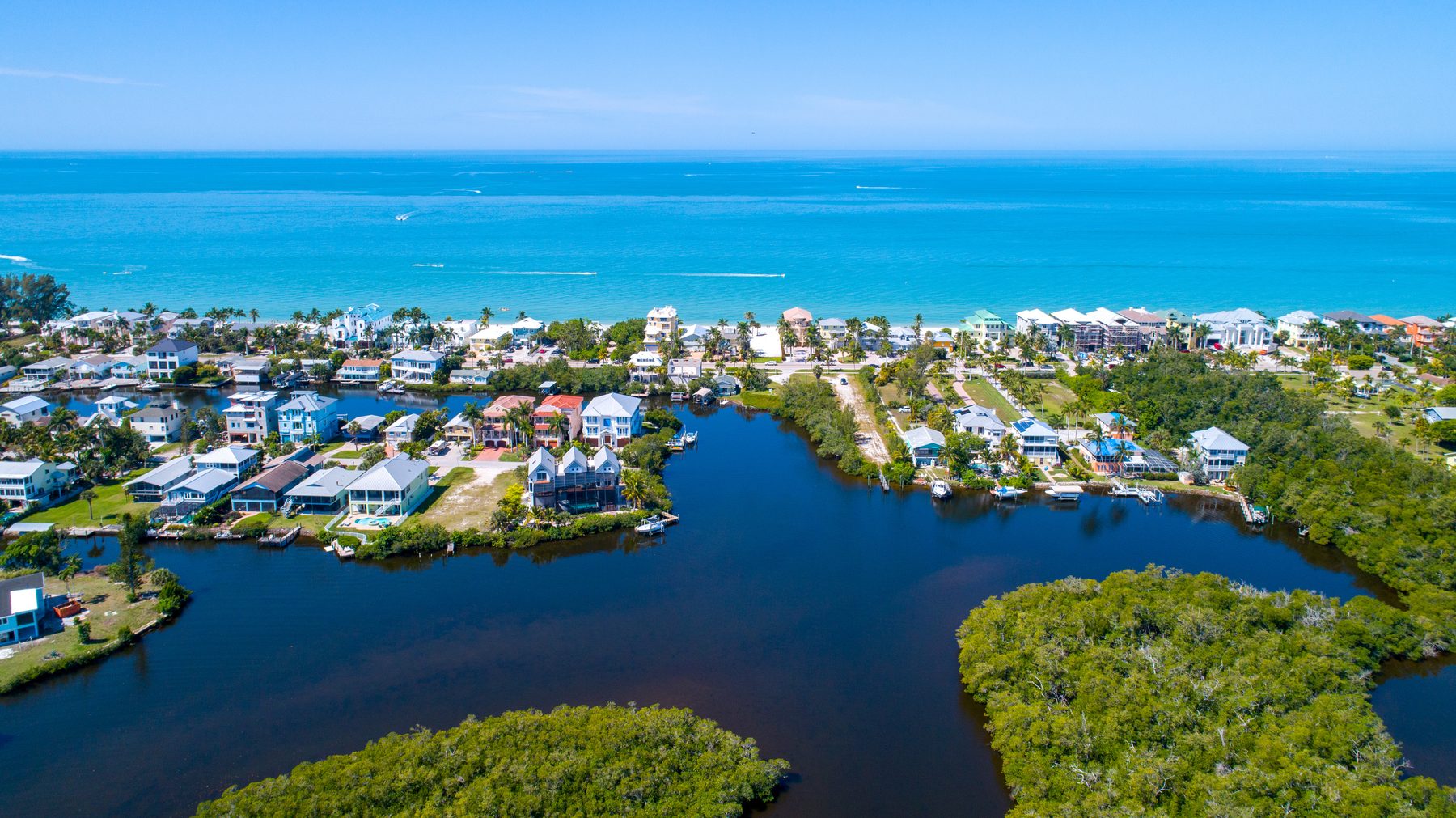
Naples Reserve is one of South Naples' most amenity-dense communities — a 688-acre neighborhood built around a 125-acre lake with a private white-sand beach, a community pontoon boat and kayak fleet included in your dues, and no golf course competing for the land. But the dues that pay for all of it come in two separate charges, not one: an HOA assessment in the mid-$400s to high-$500s a month, and a Community Development District (CDD) fee of $1,411.79 to $1,967.36 a year that shows up on your property tax bill. If you've seen Naples Reserve described online as a "no CDD" community, that's outdated information, and it's worth getting right before you make an offer.
This is one of the community buyer guides we get asked about most consistently in South Naples, and it's also one of the harder ones to research accurately — Naples Reserve has grown through eight different builders and three re-entitlements since 1999, and a lot of the fee and flood-zone details circulating online haven't kept pace with where the community actually stands in 2026.
What Naples Reserve is, and who built it
Naples Reserve sits off Greenway Road, north of US-41 East, in unincorporated Collier County — about 12 miles from downtown Naples and Marco Island. The land was originally entitled in 1999, re-entitled in 2007 for 1,154 units, and finished its horizontal infrastructure build-out in October 2021. As of June 2026, the community has 1,075 homes built across 1,088 platted homesites in eleven named neighborhoods, with the remaining lots representing the last of the new-construction inventory.
Eight builders have worked in Naples Reserve over the years: Ashton Woods, D.R. Horton, Florida Lifestyle Homes, KTS Homes, Lundstrom Development, Marvin Development, McGarvey Custom Homes, and Stock Signature Homes. That builder mix is part of why home styles vary more here than in a single-builder community — you'll see Mediterranean, Craftsman, and transitional architecture across the eleven neighborhoods, most with private pools and many with direct lake views.
That multi-builder, multi-neighborhood structure is also why "Naples Reserve" isn't really one product. Shopping the villas in Coral Harbor is a different conversation than shopping a custom lake-view estate on the luxury end, even though both carry the same HOA and gate. When you start your search, narrow by neighborhood first, not just by community name — the builder, lot size, and even the applicable CDD debt-service figure can change from one section to the next.
Homes, pricing, and what the fees actually cover
Naples Reserve's only attached product is the Coral Harbor villa collection — 178 units on 34-by-130-foot lots. Everything else is single-family, ranging from roughly 1,519 to 3,520 square feet. Based on recorded closings from 2025 into 2026, pricing breaks into four rough bands:
- Coral Harbor villas: $425,000–$575,000
- Entry and mid-tier single-family: $580,000–$890,000
- Upper-mid single-family: $750,000–$1,500,000
- Luxury, lake-view, and custom homes: $1,020,000–$2,675,000
The median resale price across the trailing 12 months of MLS closings is $886,000, and the market currently favors buyers — about 3.7 months of inventory, a 112-day median days-on-market for active listings, and 54 of the last 65 closings selling below asking price.
Where Naples Reserve asks more of a buyer is in the fee structure, and this is the part worth reading twice:
- CDD assessment: $1,411.79–$1,967.36 per year, billed through your Collier County property tax bill, covering the general fund ($717.36 per unit) and debt service on the district's infrastructure bonds ($694.43–$1,250.00, varying by neighborhood).
- HOA dues: billed quarterly, running roughly mid-$400s to high-$500s per month depending on neighborhood. This single HOA — there are no sub-associations or condo boards to layer on top — covers all amenity access, including the community's boats, kayaks, and paddleboards.
- Capital contribution at closing: a minimum of three months of annual HOA dues, due at the closing table.
- Food and beverage minimum: around $300–$400 annually at the Reserve Club restaurant.
- County trash assessment: $255.52 per year, separate from the HOA.
Run the all-in number before you fall for the lagoon. On a $750,000 home, you're looking at roughly $6,500–$8,800 a year in HOA dues on top of a CDD assessment that's closer to $1,600–$2,000 — real money that factors directly into what you can actually afford, and into your debt-to-income math if you're financing.
The current market also gives buyers more room to negotiate than the asking price alone suggests. With about 3.7 months of inventory on hand and 54 of the last 65 closings settling below list price, this isn't a market where you need to chase a number. The gap between a 112-day median time on market for active listings and a 35-day median time from under-contract to closing tells the real story: homes that are priced honestly for their neighborhood, fee structure, and flood status move fast once a seller is willing to meet the market. Homes that linger are usually overpriced for what their specific CDD and HOA numbers actually are.
Amenities and who Naples Reserve fits
What that fee structure buys is genuinely substantial. Naples Reserve's amenity package centers on Eagle Lake — 125 acres, 23 feet deep, with a one-mile rowing lane — plus 21 additional lakes bringing the community's total water acreage to 214.76 acres. Sunset Beach gives residents a white-sand beach on the lake itself, and the HOA-owned pontoon boat, kayaks, and paddleboards mean you don't need to own a boat to use the water (motors are limited to electric or sail, 22 feet max length, with a 7 mph speed limit on Eagle Lake).
On land, the Island Club clubhouse (5,160 square feet, open 6 a.m.–10 p.m.) anchors a lagoon-style zero-entry resort pool, the Reserve Club Cafe and Gazebo Bar, Match Point Tennis & Pickleball (five tennis courts, four pickleball courts), a 3,500-square-foot fitness center, a nearly two-mile linear park, Kids Cove playground, and two dog parks. The gate is staffed by security from 6 a.m. to 10 p.m. with remote monitoring overnight.
There's no golf course — a 2012 county ordinance removed the originally planned courses from the PUD in favor of more lakes and residential acreage — so this isn't the community for a buyer who wants a round of golf out the back door. It's a strong fit if what you actually want is water-based recreation without owning a boat, a genuinely active amenity calendar, and an all-ages community (Naples Reserve isn't age-restricted; it's governed under Florida Statute Chapter 720 with three public schools zoned to serve it).
Day to day, the amenity campus is built for use, not just for show. Kids Cove includes a boat launch and fishing dock on Eagle Lake alongside the playground and basketball court, so families with kids tend to gravitate there on weekends. The nearly two-mile linear park works for a daily walk or run without leaving the gates, and the fitness center's hours — 5 a.m. to 10 p.m. — accommodate early risers and evening workouts alike. If your household actually wants to use a kayak or the community pontoon boat regularly, having that equipment included in your HOA dues rather than owned and stored separately is a real convenience, not just a brochure line.
The buying process: what to check before you write an offer
Because Naples Reserve is mostly built out, most buyers today are working the resale market rather than a builder's sales center, which changes a few things about how you should approach it. A builder rep at one of the final new-construction lots represents the builder, not you — if you're looking at the last available homesites, bring your own buyer's agent before you sign a reservation agreement, not after.
For resale purchases, request the HOA estoppel letter and the most recent CDD assessment detail early in your due diligence period — the exact dollar figure varies by neighborhood and by which debt-service bonds still apply to that section, so the community-wide range we've given you here is a starting point, not your actual number. Your Florida contract's Seller's Property Disclosure should also flag any known flood history for the property.
On flood zones specifically: this is worth more than a passing mention. Roughly 98.6% of Naples Reserve's platted lots sit within a mapped FEMA Special Flood Hazard Area, though nine separate Letters of Map Revision Based on Fill (LOMR-F) have individually removed 511 of the community's 1,088 platted lots from that designation, based on engineered fill elevation at each site. Naples Reserve also falls inside Collier County's new District 6 preliminary flood map revision — the same countywide remapping effort we covered in detail in our guide to the FAR-BAR Addendum H insurance protection and Collier County's new flood maps, which opened a 90-day public appeal window in August 2026. Pull the current FEMA flood zone determination for the specific lot you're considering, not just the community in general, and ask your insurance agent for a real quote before you waive any contingencies. If you want the mechanics of capping your maximum insurance cost contractually, that Addendum H guide walks through exactly how.
Before you tour, call the HOA office directly to confirm the current quarterly dues and CDD figure for the specific neighborhood you're considering — both numbers vary enough section to section that a figure you found in an old listing or a different neighborhood's resale could be meaningfully off. In practice, that means before you write an offer on anything in Naples Reserve, you'll want to:
- Confirm the exact HOA quarterly dues and CDD annual assessment for that specific neighborhood, in writing, not from a listing sheet
- Pull the current FEMA flood zone determination for the lot, and ask whether it's covered by one of the existing LOMR-F fill revisions
- Get a real homeowners and flood insurance quote before your financing or inspection contingency expires
- Request the HOA estoppel letter and most recent budget or reserve study during your due diligence period
- Ask whether the property has ever flooded or had an insurance claim, per the Seller's Property Disclosure
How Naples Reserve compares to nearby Naples communities
If the CDD assessment and higher HOA dues give you pause, it's worth looking at two other South Naples communities with a different fee structure. Compass Landing, built out by Mattamy Homes in North Naples, carries no CDD fee at all and HOA dues around $225–$242 a month that include lawn care — roughly a third of what you'd pay in Naples Reserve's HOA alone — but its amenity package is far smaller: a clubhouse, resort pool and spa, and three lakes rather than a 125-acre lagoon and a boat fleet.
Isles of Collier Preserve, built by The Minto Group in South Naples, also carries no CDD fee, with HOA dues running $170–$450 a month depending on home type. Its identity leans toward nature and trails rather than open water — eight miles of hiking, biking, and kayaking trails along a boathouse and dock, versus Naples Reserve's larger lake and more structured amenity campus.
The honest way to frame the decision: Naples Reserve asks for more in carrying costs than either alternative, and in exchange delivers meaningfully more water acreage, a beach, an included boat fleet, and a larger clubhouse program. If the lifestyle is what you're buying, the CDD fee is the price of admission. If you're optimizing for lower monthly carrying cost in the same part of Naples, Compass Landing or Isles of Collier Preserve are worth a serious look before you commit.
Every one of these numbers moves depending on which neighborhood, builder, and phase you're looking at — that's exactly the kind of detail we walk clients through before they ever schedule a showing.