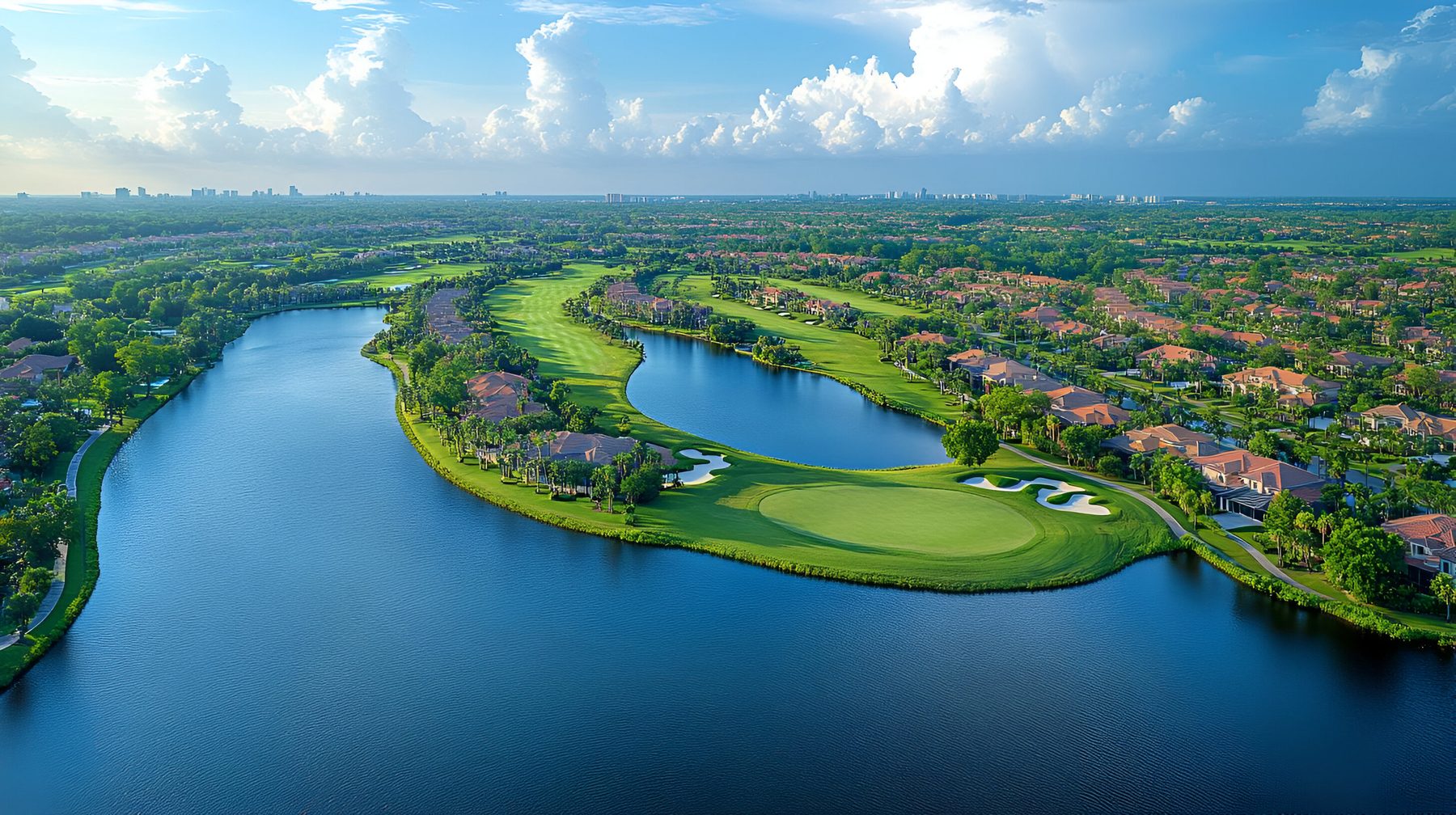
Copperleaf and Spring Run sit behind the same gates in The Brooks, share the same optional Commons Club, carry the same Brooks community development district assessment, and both bundle 18 holes of golf into ownership. On the clubs' own published numbers, Copperleaf costs about $5,800 a year more — but roughly $3,500 of that gap is a single line item, the Project 2024 assessment, which the club's own brochure describes as a 12-year charge tied to a clubhouse loan scheduled to finish in 2036. Strip that line out and the two communities are about $2,300 a year apart.
Two buyers tour The Brooks on the same weekend. One comes out of Copperleaf saying the golf is unbeatable and the clubhouse is the nicest in Estero. The other comes out of Spring Run saying it costs five thousand dollars a year less for the same number of holes. Both are right, and neither has the information that actually decides it.
Quick snapshot: both communities at a glance
What they share. Both sit inside The Brooks, a gated master-planned development of roughly 2,400 acres off Three Oaks Parkway. Both carry Bonita Springs 34135 mailing addresses but sit inside the Village of Estero — the Brooks districts describe themselves as lying within the Village boundary, which is worth confirming parcel by parcel before you write an offer. Our guide to checking whether a home is inside the Village of Estero walks through how. Both carry a Brooks CDD assessment, where FY2027 operations and maintenance runs a flat $1,017.25 per residential unit, with neighborhood-level debt lines on top. Both offer optional membership in The Commons Club, with its private Gulf beach pavilion on Little Hickory Island, fitness center, and restaurant.
Copperleaf. 570 homes — 416 single-family and 154 carriage homes — on an 18-hole Gordon Lewis course later redesigned by Kipp Schulties. That works out to roughly 32 homes per hole, the lowest density of any bundled golf community in Estero, as we detailed in our Copperleaf at The Brooks buyer's guide. The club sells a limited number of outside memberships — up to 55 Associate and 20 Social memberships a year, with a $750 non-refundable deposit to join the waitlist.
Spring Run. 847 residential units across ten neighborhoods, built 1998–2002 by Pulte for the Bonita Bay Group, on an 18-hole par-72 Gordon G. Lewis course of 6,726 yards, renovated by Sanford Golf Design. That is roughly 47 homes per hole — and the course serves those 847 homes and nobody else. No outside memberships, no waitlist, no equity buy-in.
Current inventory, same source, same day. As of October 27, 2026, subdivisions.com showed 8 Copperleaf listings from $459,900 to $1,450,000 and 3 Spring Run listings from $309,900 to $769,900 — tiny samples in communities of 570 and 847 homes, so treat them as this week's shelf, not a price trend.
Price and value: where the $5,800 actually goes
This is the part both sales offices tell you honestly and incompletely, because each one quotes its own number in its own shape.
Copperleaf, from the club's publicly posted 2025 Resident Membership flyer:
- Annual dues: $10,500
- Project 2024 assessment: $3,500
- Cable and internet: $828
- Total annual: $14,828
- Annual food and beverage minimum, charged separately: $1,000
- Committed annual total: $15,828
Spring Run, from the club's own 2026–2027 Membership at a Glance document:
- Annual club fee, effective November 1: $9,820 — and this one already includes capital, a project fund, reserve, and a $725 prepaid food minimum
- Blue Stream Fiber: $215.55
- Committed annual total: $10,035.55
The gap is $5,792 a year. And then comes the part that changes the decision.
The line item with an end date
Copperleaf's $3,500 Project 2024 assessment is not an operating cost. It is debt service on a clubhouse.
The club's own Project 2024 brochure lays it out: a $17.3 million renovation — $11.6 million builder's contract, $1.3 million food service, $1.4 million interiors, plus soft costs, interest carry, and contingency — funded by a 14-year loan, with repayment beginning February 2025 and a final payment in 2036. The brochure projected a per-door project assessment of about $2,975 a year running 12 years from 2025, replacing the prior Vision 2020 assessment of $975 a year, which ended in 2024.
By the 2025 resident flyer the actual line was $3,500, not $2,975, and the club's own 2022 projection of a $12,575 total for 2025 came in at $14,828 — worth knowing before you accept any forward-looking number from any club. The work itself is done: Copperleaf's site says Project 2024 is complete, the clubhouse gained covered outdoor dining, a reconfigured main dining room, an expanded poolside café, and a larger pro shop, and trade coverage in 2024 put the finished project at $20 million.
So here is the honest arithmetic. Take Copperleaf's project assessment out of the comparison and you get $12,328 against Spring Run's $10,035.55 — a gap of about $2,292 a year. Roughly 60% of the difference between these two communities is one scheduled charge attached to a building that already exists.
That does not mean a Copperleaf buyer should mentally discount it. You will pay it every year you own, for as long as it runs, and a board can change an assessment. It means the comparison you are actually making is between a permanent operating cost and a term obligation — and you cannot make that comparison without asking Copperleaf, in writing, what the current year's assessment is and how many years remain on it.
One more thing worth knowing: the current Copperleaf resident fee sheet sits behind a member login. The 2025 flyer is the newest one the public can read. Spring Run posts its 2026–2027 document openly. That asymmetry is not a knock on either club — it is a reminder that a number in a listing remark or a blog post is a starting point, not a closing figure.
What it costs to get in
- Copperleaf: a $15,000 capital contribution to the master association at closing for a new resident, or $5,000 for an existing Copperleaf owner buying another home there. Neighborhood associations may add their own capital reserve contribution. Master estoppel $250.
- Spring Run: a $12,000 resale fee for an outside buyer, or $3,500 for an existing Spring Run member moving within the community — both paid into the replacement reserve. Master estoppel $250, with a second neighborhood-level estoppel to expect on top.
Neither is an initiation fee you get back. A national survey of bundled-golf communities puts typical annual dues at $4,000 to $8,000 and notes that bundled memberships carry no equity return at resale — both of these clubs sit above that band, which is what 18 holes carried by a few hundred households looks like.
Amenities head-to-head
Golf. Copperleaf gives you a lower-density course and a brand-new clubhouse, but the tee sheet is not yours alone — up to 55 Associate memberships a year means outside players. Spring Run gives you a residents-only sheet at higher density. Member cart fees are nearly identical: $31 for 18 holes at both clubs, $20 at Copperleaf and $21 at Spring Run for nine. Copperleaf charges guest green fees on a seasonal scale, from $55 in summer to $125 from January through April. Spring Run charges members no green fee.
Everything else. This is where the two genuinely converge. Both draw on The Commons Club, where 2025 tiers ran Bronze at $1,000 equity and about $490 a year, Silver at $6,000 and about $1,831, and Gold at $12,000 and about $2,385 — with Silver and Gold carrying a $125.98 renovation fee through 2030, and Gold the only tier that includes the Beach Club. If the private Gulf beach is the reason you are looking at The Brooks at all, that is a separate decision from which gate you buy behind, and it costs the same either way.
Housing stock. Copperleaf spans single-family and carriage homes and reaches well past $1 million. Spring Run is predominantly two-story condominium buildings — 67 of them, none with elevators — plus fee-simple parcels, and the entry price is meaningfully lower. If a second-floor unit without an elevator is a problem for how you plan to live in ten years, that is a real constraint, and it only applies to one of these two.
Who each community is best for
Copperleaf fits you if you will play most weeks, you want the newest clubhouse in The Brooks, you want a single-family home, and the budget absorbs roughly $15,800 a year of committed club cost plus a $15,000 capital contribution at closing without strain.
Spring Run fits you if you want bundled golf at the lowest entry price in The Brooks, you are content in a condominium, you would rather have a residents-only tee sheet than a newer building, and you would rather pay about $10,000 a year than $15,800 for the same 18 holes.
Neither fits you if you are not sure you will play. In both communities golf comes with the deed — there is no social-only tier to retreat to. Shadow Wood at The Brooks, behind the same gates, makes golf optional across 54 holes, and that is the right question to settle before you narrow to these two at all. If bundled golf at a different price point is what you are really testing, Pelican Sound is the other end of the Estero range.
Buying process differences, and our recommendation
The mechanics diverge in ways that cost people money.
Spring Run's 847 units sit under ten neighborhood associations managed by three different companies, so the fee you are quoted at a showing is the club fee — your neighborhood association fee is a separate number from a separate office. Copperleaf's neighborhoods likewise may levy their own capital reserve contribution on top of the master's $15,000. In both cases you will be ordering more than one estoppel certificate, and the document that tells you the truth is the one from the sub-association, not the master. Our guide to evaluating a Florida HOA before you buy covers what to read in each.
Rentals differ too. Spring Run requires a delegation of use at $550 plus 6.5% tax, which includes the rental administration fee — and delegating suspends the owner's own club access for the lease term. If your plan is to rent the place out for a few seasons before you move down full time, that is a material fact, and it rarely comes up on a tour.
What would we look at first if you called us about these two?
The first thing we would ask for is not a listing. It is the current fee schedule from each club and, for Copperleaf, the remaining term on the Project 2024 assessment in writing. The published $14,828 is a 2025 figure and the current sheet is behind a member login — so until someone confirms this year's number and how many years are left on that line, you are comparing a 2025 price to a 2026–2027 price and calling it a gap.
Then we would pull the neighborhood-level documents, not just the master's. At Spring Run that is where a second fee and a second estoppel live, and a community with ten associations and three management companies has ten different answers to "what are the fees." At Copperleaf it is where a second capital contribution can appear.
After that it comes down to what actually separates these two for most buyers: whether you will play enough golf to justify either number, and whether a residents-only tee sheet at higher density beats a newer clubhouse with outside play. That is a lifestyle question with a dollar answer, and the dollar answer changes depending on which neighborhood you buy in. What you get is a comparison built on current documents instead of marketing sheets, so the number you budget is the number that shows up. That's the part we take care of for you.
Our recommendation. If you play regularly and the budget is comfortable, Copperleaf's combination of 32 homes per hole and a finished $20 million clubhouse is the better golf product — and you should buy it knowing that a meaningful share of what you pay is debt service with a scheduled end. If the annual number is the constraint, Spring Run delivers the same 18 holes, a tee sheet closed to outsiders, and a lower entry price, with a simpler cost structure because no term assessment is sitting inside it. These two communities are not competing on quality. They are competing on how you would rather fund a golf course.
One note on flood and insurance, since it comes up on every Brooks tour: the Village of Estero's Community Rating System classification applies to both communities identically, and we cover how to check a specific parcel in our guide to checking a home's flood risk in Estero. It is not a differentiator between these two. The CDD, the neighborhood association, and the club fee are — and our CDD fee guide explains how that assessment lands on your Lee County tax bill.
Frequently asked questions
Is Copperleaf or Spring Run cheaper to own?
Spring Run, by roughly $5,800 a year on committed club costs — about $10,036 against about $15,828. Roughly $3,500 of that difference is Copperleaf's Project 2024 assessment, a term charge tied to a clubhouse loan scheduled to run to 2036. Confirm both clubs' current-year figures before you budget.
Do both communities pay a CDD fee?
Yes. Both sit inside a Brooks community development district, where FY2027 operations and maintenance is a flat $1,017.25 per residential unit, with neighborhood-level debt lines on top that vary by location. The assessment appears on your Lee County tax bill rather than as a separate invoice.
Can I buy in either community and skip golf?
No. Golf comes bundled with ownership at both Copperleaf and Spring Run — there is no social-only tier for residents and no way to opt out. Copperleaf sells a limited number of Associate and Social memberships to people who live off-property, but that is the reverse of what a resident is asking.
Is the private beach included in either community's fees?
No. The Gulf beach pavilion sits behind The Commons Club, a separate optional membership at The Brooks, and in 2025 only the Gold tier included Beach Club access. Verify current tiers and pricing with the Commons Club directly, since those figures change.
Why is Spring Run's entry price so much lower?
Spring Run is mostly two-story condominium buildings from 1998–2002, with no elevators, while Copperleaf includes single-family homes reaching past $1 million. The club cost difference and the housing-stock difference are two separate things, and buyers often conflate them.
Deciding between the two
The headline gap is about $5,800 a year, and most of it is one assessment with an end date rather than a permanent difference in what the two clubs cost to run. Once you know that, the question stops being "which is more expensive" and becomes "which cost structure do I want to own."
We can pull the current fee schedules, the neighborhood-level documents, and the sold data for both before you ever walk a model. Start with our Southwest Florida Community Guides for The Brooks, or go wider with our Estero buyer's guide, then call or text us at 239-350-4474.
About Mark & Dawn Borg. Mark & Dawn Borg lead The Borg Group at Downing-Frye Realty, a luxury real estate team serving Southwest Florida's most sought-after communities — from Bonita Springs and Estero to Naples, Fort Myers, and Cape Coral. With deep roots in the local market and combined expertise spanning single-family homes, condos, new construction, waterfront properties, and investment real estate, they specialize in guiding buyers relocating from out of state, sellers ready to make their next move, and clients seeking their perfect piece of Southwest Florida. Reach the team at theborggroup.com or by phone at 239-350-4474 | 239-293-1616. Live Where Life Feels Better.
Copperleaf figures come from its public 2025 Resident Membership flyer and its Project 2024 brochure; Spring Run figures come from its 2026–2027 Membership at a Glance document. All amounts are subject to change by the governing boards — verify current figures, assessment terms, and neighborhood association fees in writing before you contract.